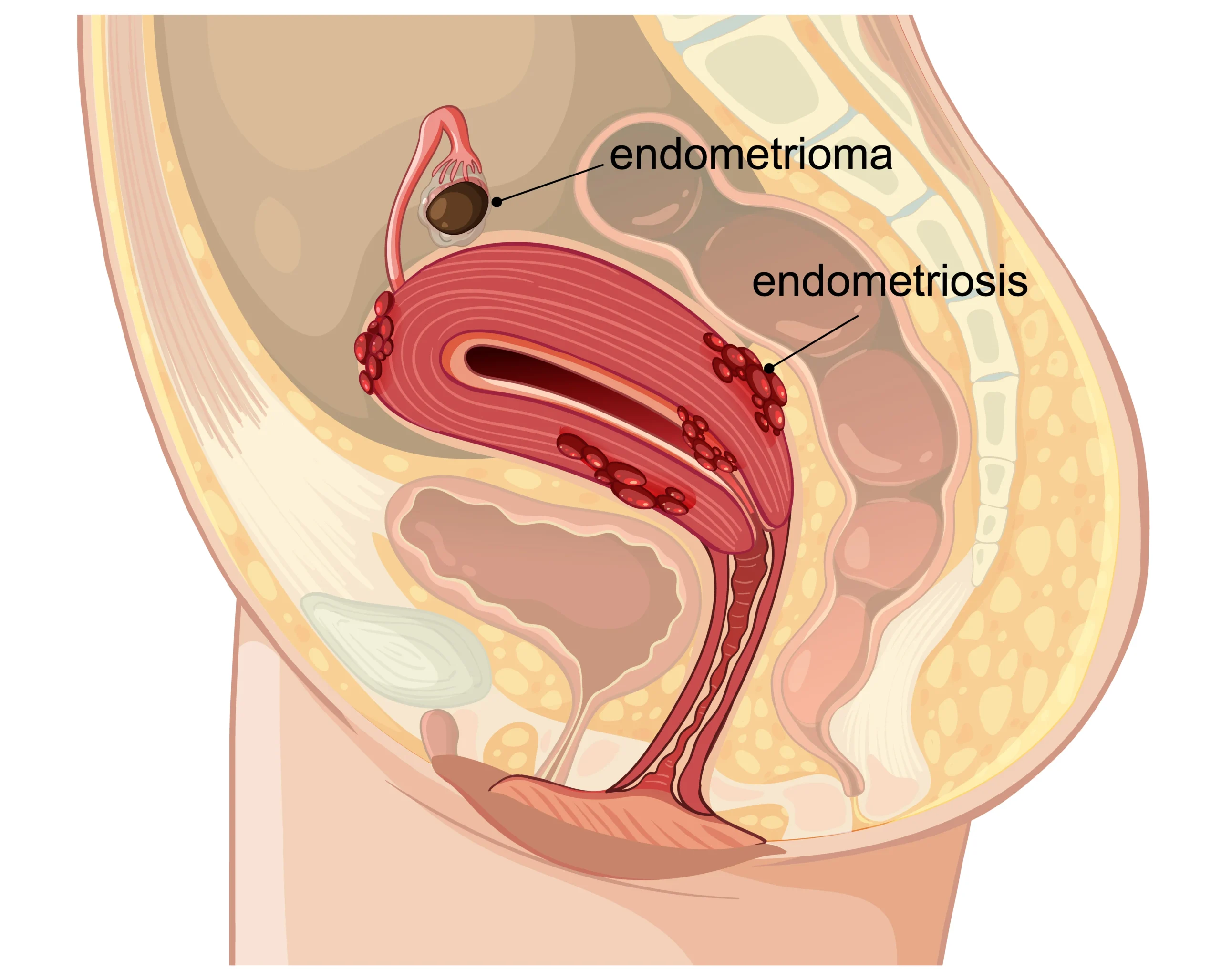
Endometriosis affects an estimated 42 million women in India — yet it takes an average of 7–10 years to get a confirmed diagnosis. When surgery is finally recommended, many women face a question they weren’t prepared for: laparoscopy or open surgery?
It’s a decision that affects your recovery time, your future fertility, your scarring, and your quality of life in the weeks that follow. And it deserves a clear, honest answer — not a rushed five-minute conversation in a consultation room.
Here’s what you need to know.
What Is Endometriosis and Why Does It Sometimes Need Surgery?
Endometriosis is a condition where tissue similar to the uterine lining grows outside the uterus — on the ovaries, fallopian tubes, pelvic walls, and in some cases the bowel or bladder. This tissue responds to monthly hormonal cycles just like the uterine lining does: it thickens, breaks down, and bleeds. But unlike menstrual blood, it has nowhere to go — leading to inflammation, adhesions (scar tissue), and cysts called endometriomas.
The result is often debilitating pain during periods, chronic pelvic pain, pain during intercourse, and difficulty conceiving. If you’ve been experiencing these symptoms, learn more about Menstrual Disorder Management at CareForHer.
Not every woman with endometriosis needs surgery. Hormonal therapy is often the first line of management. Surgery becomes necessary when:
- Symptoms are severe and not controlled by medication
- Endometriomas (ovarian cysts caused by endometriosis) are present and growing
- Significant adhesions are affecting organ function
- Fertility is being impacted and surgical correction may improve outcomes
- A definitive diagnosis is needed (laparoscopy is the gold standard for diagnosis)
Laparoscopy for Endometriosis: The Gold Standard
Laparoscopy — also called minimally invasive or keyhole surgery — is widely considered the preferred surgical approach for endometriosis. The surgeon makes 3–4 small incisions (0.5–1.5 cm) in the abdomen and inserts a camera (laparoscope) and thin surgical instruments to visualise and treat the disease.
Laparoscopy is used both to diagnose endometriosis (it’s the only way to confirm the condition definitively) and to treat it — removing or destroying endometrial lesions, draining or removing endometriomas, and cutting through adhesions.
Why Laparoscopy Is Preferred:
- Faster recovery — most women return home within 24–48 hours and resume normal activities within 1–2 weeks
- Less blood loss — significantly lower than open surgery
- Smaller scars — 3–4 tiny incisions versus one large abdominal cut
- Lower infection risk — reduced exposure of internal organs
- Better visualisation — high-resolution cameras can detect small endometrial implants that might be missed with the naked eye in open surgery
- Fertility preservation — less trauma to surrounding tissue means better protection of the ovaries and fallopian tubes
For most women with mild to moderate endometriosis, laparoscopy offers complete disease removal with outcomes comparable to open surgery — but with a fraction of the recovery time.
At CareForHer, Dr. Anuja Ojha performs laparoscopic procedures for endometriosis as part of comprehensive Gynaecological Surgeries & Procedures.
Open Surgery (Laparotomy) for Endometriosis: When It’s Necessary
Open surgery — or laparotomy — involves a single larger incision in the abdomen to access the pelvic cavity directly. The surgeon can see and feel the affected tissue with their hands, which can be an advantage in certain complex cases.
Open surgery is generally not the first choice for endometriosis, but it remains an important option in specific situations:
- Deeply infiltrating endometriosis (DIE) — where the disease has penetrated deeply into the bowel, bladder, or ureters, requiring complex multi-organ surgery
- Extensive pelvic adhesions — thick scar tissue that makes laparoscopic navigation difficult or risky
- Very large endometriomas — cysts too large to safely manage with keyhole instruments
- Previous multiple abdominal surgeries — scar tissue from prior operations may obstruct laparoscopic access
- Intraoperative conversion — sometimes a laparoscopy is started and converted to open surgery mid-procedure when unexpected complexity is found; this is a safety decision, not a failure
Risks of Open Surgery vs Laparoscopy:
- Larger scar and longer wound healing
- Hospital stay of 3–5 days (versus 1–2 days for laparoscopy)
- Full recovery takes 6–8 weeks (versus 1–2 weeks for laparoscopy)
- Higher risk of wound infection and blood loss
- More post-operative pain in the immediate recovery period
Laparoscopy vs Open Surgery: Side-by-Side
| Laparoscopy | Open Surgery (Laparotomy) | |
| Incisions | 3–4 small (0.5–1.5 cm) |
1 large (10–15 cm) |
|
Hospital stay |
1–2 days | 3–5 days |
| Recovery time | 1–2 weeks |
6–8 weeks |
|
Blood loss |
Lower | Higher |
| Infection risk | Lower |
Higher |
|
Scarring |
Minimal | More significant |
| Visualisation | High-resolution camera |
Direct vision and touch |
|
Ideal for |
Mild to moderate endometriosis, fertility preservation | Deep, complex, or extensive disease |
| Pain post-op | Mild to moderate |
More significant |
|
Fertility impact |
Lower tissue trauma |
Higher trauma; more adhesion risk |
Excision vs Ablation: Another Key Choice Within Laparoscopy
Within laparoscopic surgery, there’s a further distinction worth knowing:
- Excision — the endometrial lesion is cut out and removed entirely. This is the preferred method as it removes the disease at the root and is associated with lower recurrence rates.
- Ablation (or fulguration) — the surface of the lesion is burned or destroyed using heat or laser. It is faster but leaves the deeper tissue behind, which can mean higher recurrence.
When discussing surgery with your gynaecologist, ask specifically about their approach — excision is the evidence-based gold standard, particularly for women with moderate to severe disease or fertility goals.
Endometriosis Surgery and Fertility
Surgery for endometriosis — particularly laparoscopic excision of endometriomas and adhesions — can significantly improve the chances of natural conception. However, it must be approached carefully: removing tissue from the ovaries, even when indicated, can reduce ovarian reserve.
If you’re planning to conceive, this is a critical conversation to have before surgery. In some cases, proceeding directly to IVF without surgical intervention may be a better strategy, depending on the extent of disease and your ovarian reserve. A thorough discussion with a specialist in Infertility Treatment at CareForHer can help map the right path for you.
Questions to Ask Your Surgeon Before Deciding
Before consenting to any surgical approach for endometriosis, ask:
- Is surgery truly necessary at this stage, or can hormonal therapy be tried first?
- Am I a candidate for laparoscopy, or is my disease too complex?
- Will you be performing excision or ablation?
- How experienced are you with deep infiltrating endometriosis?
- What is the plan if laparoscopy needs to convert to open surgery?
- How will this surgery affect my fertility and ovarian reserve?
At Care For Her in Goregaon East, Dr. Anuja Ojha takes the time to answer every one of these questions before any procedure. If you’ve been diagnosed with endometriosis or suspect you may have it, a specialist evaluation is the essential first step.
Also consider a routine gynaecological check-up if you’ve had persistent pelvic pain, painful periods, or difficulty conceiving — endometriosis is frequently missed without targeted investigation.
Book a consultation with Dr. Anuja Ojha, Gynaecologist in Goregaon East →
Frequently Asked Questions (FAQs)
Q1. Is laparoscopy the best surgery for endometriosis?
Yes, for most women. Laparoscopy is the gold standard — it diagnoses and treats endometriosis in a single procedure, with faster recovery, smaller scars, and lower infection risk than open surgery.
Q2. When is open surgery needed for endometriosis?
Open surgery is considered when the disease is deeply infiltrating (involving the bowel or bladder), when adhesions are too extensive for keyhole access, or when a laparoscopy is converted mid-procedure due to unexpected complexity.
Q3. How long is recovery after laparoscopy for endometriosis?
Most women go home within 24–48 hours and return to normal activities within 1–2 weeks. Full internal healing takes 4–6 weeks. Open surgery recovery takes significantly longer — typically 6–8 weeks.
Q4. Can endometriosis surgery improve fertility?
Yes, in many cases — particularly when endometriomas or adhesions are blocking the fallopian tubes or affecting ovulation. However, surgery near the ovaries can reduce ovarian reserve, so the decision must be carefully weighed against other options like IVF.
Q5. What is the difference between excision and ablation in laparoscopy?
Excision cuts the lesion out completely and is associated with lower recurrence rates. Ablation burns the surface but leaves deeper tissue intact, which can mean the disease returns sooner. Excision is the preferred approach for most cases.
Q6. Will endometriosis come back after surgery?
Endometriosis can recur after surgery, particularly if ablation rather than excision is used, or if the disease was extensive. Hormonal therapy after surgery is often recommended to reduce recurrence risk.
Q7. How do I know if I need surgery for endometriosis?
Surgery is considered when symptoms are severe, not controlled by medication, when endometriomas are present, or when fertility is being affected. A gynaecologist will assess your case through examination, ultrasound, and symptom history before recommending surgery.
Citations & References
- Endo Excellence Center. Open vs. Laparoscopic Surgery for Endometriosis (2025). Published June 2025. endoexcellencecenter.com
- Dr. Senai Aksoy. Laparoscopy vs Open Surgery: Risks — A Fertility Surgeon’s Evidence Review. Reviewed July 2026. draksoyivf.com
- Jain V, Bhaumik J, et al. Surgical Outcomes of Open, Laparoscopic, and Robotic-Assisted Approaches for Stage I Endometrial Cancer: Insights From the Indian Gynecologic-Onco Study Group. Cureus. Published August 2025. ncbi.nlm.nih.gov
- Zhou X, et al. Laparoscopic vs. open procedure for intermediate‑ and high‑risk endometrial cancer: a minimum 4-year follow-up analysis. BMC Cancer. 2022. ncbi.nlm.nih.gov
- ESHRE Endometriosis Guideline Development Group. Endometriosis: ESHRE Guideline 2022. European Society of Human Reproduction and Embryology. eshre.eu
- American College of Obstetricians and Gynecologists (ACOG). Endometriosis: Frequently Asked Questions. acog.org
- ClinicalTrials.gov. Robotic Versus Laparoscopic Surgery for Deep Endometriosis. NCT05179109. clinicaltrials.gov
This blog is for informational purposes only and does not constitute medical advice. For a personalised evaluation, consult Dr. Anuja Ojha at Care For Her, Goregaon East, Mumbai — book online or call 7400424637.